LATEST ANNOUCEMENTS
California Workers’ Comp Case Law Update: A Deep Dive into Decisions Shaping Practice
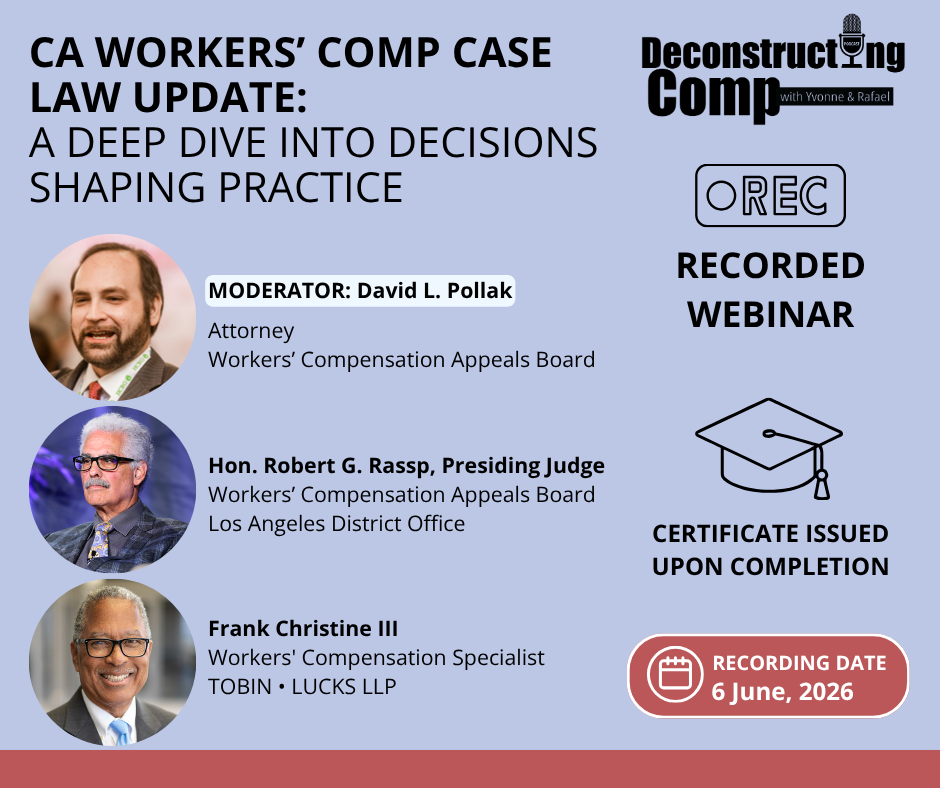
Presented as part of the Deconstructing Comp Educational Webinar Series
RECORDING DATE: June 6, 2026
On-demand webinar available for purchase.
A certificate of completion will be provided for self-submission and reciprocal CE credit approval through your licensing organization.
AGENDA
- 30 min Opening Overview: Trends Shaping Recent WCAB and Appellate Decisions
- 1 hour Permanent Disability Ratings and Medical Evidence
- 1 hour Jurisdictional Defenses and Medical-Legal Procedure
- 1 hour Discovery Obligations, Evidence, and Due Process
- 30 min BREAK
- 1 hour Employment Status, UEBTF Liability, and Statute of Limitations
- 30 min Program Synthesis and Practice Takeaways
California Workers’ Comp Case Law Update: A Deep Dive into Decisions Shaping Practice
Staying current on California workers’ compensation case law is essential for attorneys, claims professionals, and industry leaders navigating an increasingly complex legal landscape. This five-hour, in-depth webinar provides a comprehensive review of the most impactful California Workers’ Compensation Appeals Board and appellate decisions issued over the past two years, with a sharp focus on how these rulings are actively reshaping litigation strategy, medical-legal procedure, and benefit determinations across California.
Presented by David Pollak, Judge Robert G. Rassp, and Frank Christine III, this program goes well beyond headline summaries. The panel brings together judicial insight and hands-on litigation experience to examine not only what the law says, but how it is being interpreted, challenged, and applied in real-world cases throughout the state.
The interactive format is designed to keep participants engaged while delivering serious substance. Pollak anchors the session with an entertaining yet highly educational presentation that walks through each decision in a clear, accessible way. From there, the panel analyzes the cases from multiple perspectives: applicant, defense, and judicial, highlighting practical implications, evidentiary requirements, procedural pitfalls, and emerging trends that every practitioner needs to understand.
Attendees will gain critical insight into how subtle procedural missteps can waive defenses, how medical-legal reporting must evolve to meet heightened standards of substantial evidence, and how recent rulings are influencing outcomes in areas such as permanent disability, discovery, jurisdiction, uninsured employers, and cumulative trauma claims. Whether you are litigating cases, managing complex claims, advising clients, or making high-stakes strategic decisions, this program equips you with actionable knowledge you can immediately apply.
This is not a cursory update; rather, it is a deep dive intended for professionals who want to stay ahead of the curve, reduce risk, and practice more effectively in the California’s workers’ compensation system.
Featured Cases and Issues to Be Reviewed
Participants will examine recent WCAB and appellate decisions addressing critical issues that directly impact California workers’ compensation practice, including:
Permanent Disability & Rating Rebuttal
Sammy Vigil v. County of Kern – When and how the Combined Values Chart may be rebutted, and what constitutes substantial medical evidence to support adding impairment ratings based on activities of daily living.
Personal Jurisdiction & Waiver
Paul Pirowski v. Dallas Cowboys et al. – How failure to timely and properly assert jurisdictional defenses can result in waiver, including in extraterritorial and multi-state employment claims.
Medical-Legal Procedure & QME Panels
Alma Justo v. Consolidated Staffing Solutions – The right to obtain multiple QME panels when additional defendants are joined, and the limits of judicial discretion to strike panels.
Discovery & Video Evidence
Coreen Gonzales v. Sage Millimeter, Inc. – Disclosure obligations for video evidence depicting the mechanism of injury and why tactical withholding prior to deposition may be improper.
Uninsured Employers & Bankruptcy
Adan Manuel Martinez v. Bob Williams Moving – Why employer bankruptcy does not bar injured workers from pursuing benefits through the Uninsured Employers Benefits Trust Fund.
Special Employment & Right of Control
Victor Calderon v. Unified Protective Services – Application of the Borello factors where multiple entities exercise direction and control over a worker’s duties.
Statute of Limitations in Cumulative Trauma Claims
Lance D. Miraco v. City of Salinas – Clarifying the distinction between injurious exposure and the legally operative date of injury under Labor Code sections 5412 and 5500.5.
Additional recent decisions will be incorporated to ensure the program reflects the most current legal developments at the time of presentation.
Footer